

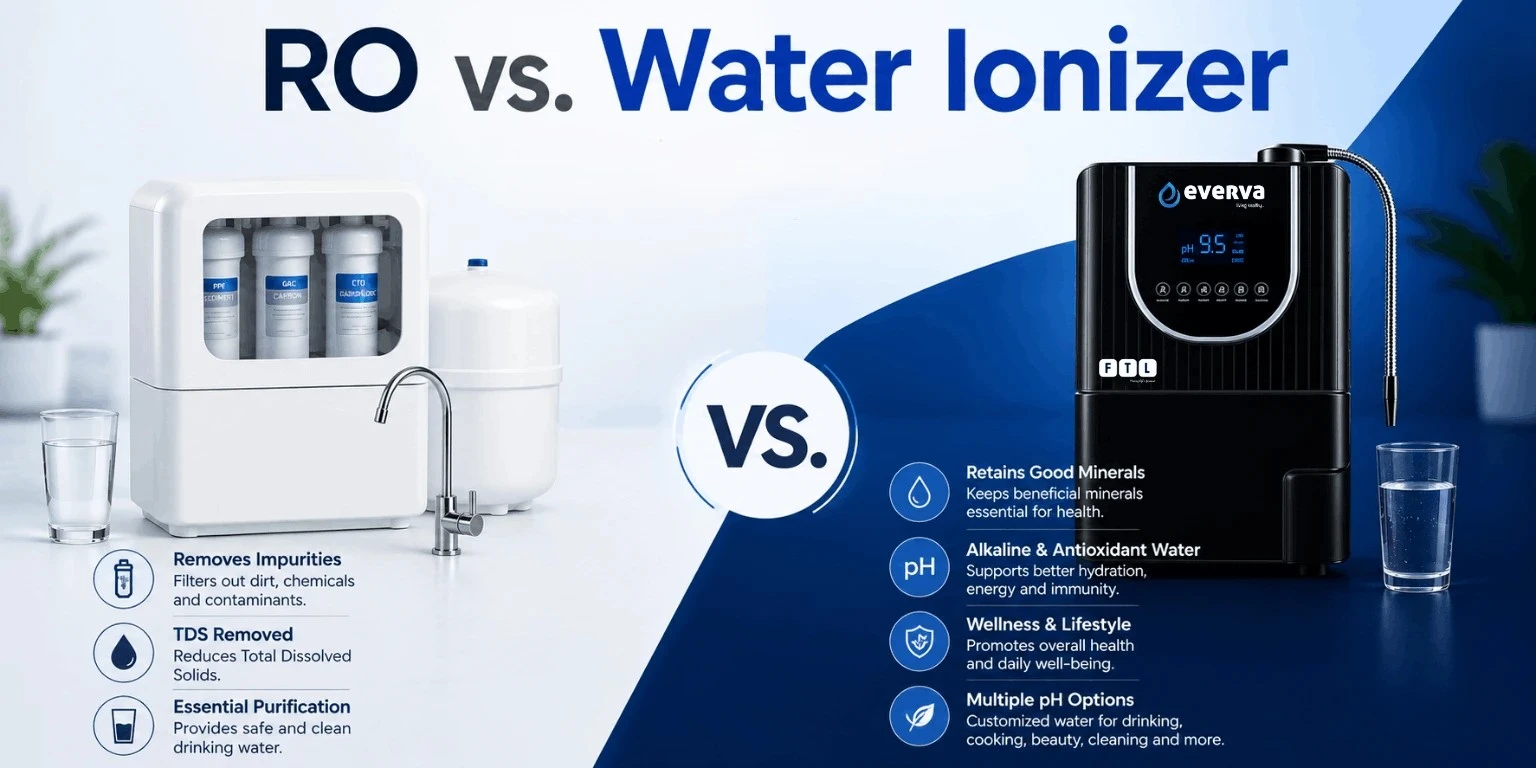
For years, Reverse Osmosis (RO) water purifiers have been a household essential across India. They remove impurities, reduce Total Dissolved Solids (TDS), and make water suitable for drinking in areas where water quality is poor.
“If my water is already purified, is there anything more I can do to improve my daily drinking water?”
This is where many people discover water ionization.
A common misconception is that a water ionizer replaces an RO purifier. In reality, the two technologies perform different roles and can complement each other.
Understanding Reverse Osmosis (RO)
Reverse Osmosis is a filtration process that pushes water through a semi-permeable membrane to remove many dissolved salts, heavy metals, microorganisms, and other contaminants.
Its primary goal is purification.
An RO system is especially useful in areas with high TDS levels or poor-quality source water because it improves water safety by reducing unwanted impurities.
However, once purification is complete, the water has simply become clean drinking water. An RO system is not designed to change the water’s pH or create ionized water.
What Is a Water Ionizer?
A water ionizer is not another purifier.
Instead, it is a device that works with already purified water.
EVERVA uses advanced water ionization technology to separate water into alkaline and acidic streams through a process called electrolysis. This process changes the characteristics of the water while retaining essential minerals required for ionization.
Rather than replacing your purifier, EVERVA is designed to work alongside your existing filtration system, adding a stage after purification.
RO and EVERVA: Two Different Jobs
Think of your drinking water in two stages.
Stage 1 – Purification
Your existing RO or water purifier removes unwanted contaminants and prepares the water for consumption.
Stage 2 – Water Ionization
EVERVA then converts that purified water into alkaline ionized water through electrolysis, offering multiple types of water for different household uses.
This is why the two technologies should not be viewed as competitors—they serve different purposes.
The Difference
| Feature | RO Water Purifier | EVERVA Water Ionizer |
| Primary Purpose | Purifies water | Ionizes purified water |
| Removes impurities | ✔ Yes | Requires purified water as input |
| Reduces TDS | ✔ Yes | No |
| Uses electrolysis | ✘ No | ✔ Yes |
| Produces alkaline water | ✘ No | ✔ Yes |
| Produces multiple water types | ✘ No | ✔ Yes |
| Designed to complement the existing purifier | — | ✔ Yes |
Why Does pH Matter?
The pH scale measures how acidic or alkaline water is.
A pH of 7 is considered neutral.
Values below 7 are acidic, while values above 7 are alkaline.
Many foods and beverages in modern lifestyles, such as carbonated soft drinks, processed foods, and alcohol, are acidic.
EVERVA is designed to produce alkaline ionized water from purified water. Many users choose alkaline water as part of their overall hydration and wellness routine.
While alkaline water is popular among wellness enthusiasts, it should be viewed as one aspect of a balanced lifestyle rather than a substitute for healthy eating or medical care.
The Science Behind EVERVA
After purified water enters the EVERVA system, electrolysis separates the water into alkaline and acidic streams.
According to the EVERVA product range, this enables one machine to generate different types of water suitable for various household applications, including:
- Drinking water
- Beauty water
- Strong alkaline water for cleaning fruits and vegetables
- Strong acidic water for household cleaning and hygiene
- Purified water
This multi-purpose functionality allows one system to support several everyday needs beyond drinking water.
Why Many Families Choose BOTH
Rather than asking, “RO or Water Ionizer?” a better question is, “How can they work together?”
An RO system helps ensure your water is purified.
EVERVA then adds a second layer by transforming that purified water into alkaline ionized water for daily use.
For families looking beyond basic purification, combining purification with water ionization offers a more comprehensive approach to everyday hydration.
Which Option Is Right for You?
If your concern is contaminated water or high TDS, an RO purifier remains an important first step.
If you already have a purifier and want to explore the benefits of alkaline ionized water, EVERVA is designed to complement your existing system rather than replace it.
Together, they create a two-stage approach: Purify first. Ionize next. Hydrate better.
Why Choose EVERVA?
EVERVA combines advanced Japanese water ionization technology with modern household convenience.
Designed to integrate with compatible filtration systems, it transforms purified water into multiple types of ionized water suitable for drinking, cooking, beauty care, and everyday household use.
Conclusion
Clean water is essential. But for many households, the conversation doesn’t end with purification.
Understanding the difference between purification and ionization helps you make informed decisions about your family’s drinking water.
With an existing purifier and EVERVA working together, you can move from simply clean water to purified, ionized water designed for everyday wellness.
Healthy Water. Healthy Life.
Frequently Asked Questions—for website
Can EVERVA replace my RO purifier?
No. EVERVA is designed to work with already purified water. It complements your existing filtration system by adding water ionization.
Does EVERVA reduce TDS?
No. TDS reduction is typically handled by your purifier. EVERVA’s role is water ionization after purification.
Why do I need both?
Purification and ionization perform different functions. Using both allows you to first clean the water and then produce alkaline ionized water for everyday use.
Is alkaline water safe for daily drinking?
Many people include alkaline water as part of their hydration routine. If you have kidney disease or another medical condition that affects mineral balance, consult your healthcare professional before making significant changes to your water intake.