
For most Indian families, clean drinking water starts with one question: Is my water purifier doing its job?
RO systems, UV purifiers, water filters, and other purification technologies have become a common part of Indian homes. They help address concerns related to impurities and make treated water more suitable for drinking.
But today, families are beginning to ask a different question:
Is purified water the end goal, or should we think about what comes after purification?
This shift is important because drinking water is not simply about removing unwanted substances. It is also about the kind of water we consume every day and how it fits into our overall hydration habits.
Purification Is Important — But It Is Only One Part of the Picture
The first priority should always be safe and appropriately treated drinking water.
Depending on the source, water can contain suspended particles, microorganisms, dissolved substances, or other contaminants. This is why home water purification systems have become so important.
However, purification primarily focuses on water treatment.
Once water has been treated, families can also consider other characteristics of their drinking water, such as its mineral content, pH and overall drinking experience.
That is where the idea of going beyond water purification comes in.
What Does “Beyond Purification” Actually Mean?
Going beyond purification does not mean replacing a water purifier.
Instead, it means looking at what can be added to the drinking-water experience after or alongside the existing filtration and purification process.
For example, some modern water solutions are designed to alter characteristics such as:
- pH level
- water ionization
- mineral balance
- taste and drinking experience
This has led to growing interest in alkaline water and water ionizers among consumers looking for alternatives to conventional purified water.
Why Are Indian Families Exploring Alkaline Water?
The human body naturally regulates its internal pH, so drinking alkaline water should not be presented as a treatment or cure for health conditions.
However, alkaline water has become an area of interest because of its higher pH compared with neutral water.
The pH scale ranges from 0 to 14:
| pH Level | Description |
| Below 7 | Acidic |
| 7 | Neutral |
| Above 7 | Alkaline |
Many alkaline-water systems produce water in a mildly alkaline range.
For families already using a water purifier for home, the concept can be particularly interesting because some systems can work alongside existing filtration rather than requiring an entirely new purification setup.
Purified Water vs. Water Designed for More
It is useful to understand that purification and ionization are not the same thing.
Water purification focuses on treating water by reducing or removing specific contaminants, depending on the technology used.
Water ionization, on the other hand, is a process designed to modify certain properties of treated water, including its pH.
That means the two concepts can serve different purposes.
Think of it this way:
Purification → focuses on water treatment.
Ionization → focuses on modifying certain properties of treated water.
For this reason, families should not necessarily view them as competing technologies.
Do You Need to Replace Your Existing Water Purifier?
Not always.
One of the practical advantages of some modern water-ionization solutions is that they can be designed to work with an existing water filtration or purification system.
This can be useful for families who have already invested in an RO, UV or other filtration system but are interested in exploring alkaline or ionized water.
Instead of completely changing the setup, an additional solution may be considered depending on the existing system, water quality and household requirements.
Of course, compatibility should always be checked before installation.
Why This Matters for Indian Homes
Indian households deal with very different water sources and conditions.
Depending on the location, families may receive water from municipal supplies, borewells, tankers, packaged sources or a combination of these. Water quality can also vary between cities, neighbourhoods and even buildings.
This makes it difficult to have a single best water purification system for every home.
The right approach should begin with understanding the water source and choosing suitable treatment technology.
Once safe drinking water is addressed, families can then explore additional options based on their preferences and needs.
The Bigger Conversation: Water and Everyday Hydration
There is another part of the conversation that is often overlooked: how much water we actually drink.
Busy work schedules, school routines, travel, hot weather and sedentary lifestyles can all influence everyday drinking habits.
A sophisticated water system cannot replace the simple habit of drinking adequate water throughout the day.
The goal should therefore be straightforward:
Start with appropriately treated water. Then make drinking water a consistent part of everyday life.
Any additional water technology should complement—not replace—good hydration habits and a balanced lifestyle.
A Smarter Way to Think About Drinking Water
The future of home water solutions may not simply be about asking:
“Which purifier removes the most?”
Instead, families can start asking:
“What kind of drinking-water solution is right for our home?”
That includes considering:
- The source of your household water
- Existing purification technology
- Water quality and testing
- Maintenance requirements
- pH and other desired water characteristics
- Household preferences
- Long-term convenience
This broader approach can help families make more informed decisions rather than choosing a system based only on a single feature.
Everva: Going Beyond Conventional Water Purification
Everva by FTL Enterprises is designed around this idea of going beyond conventional water purification.
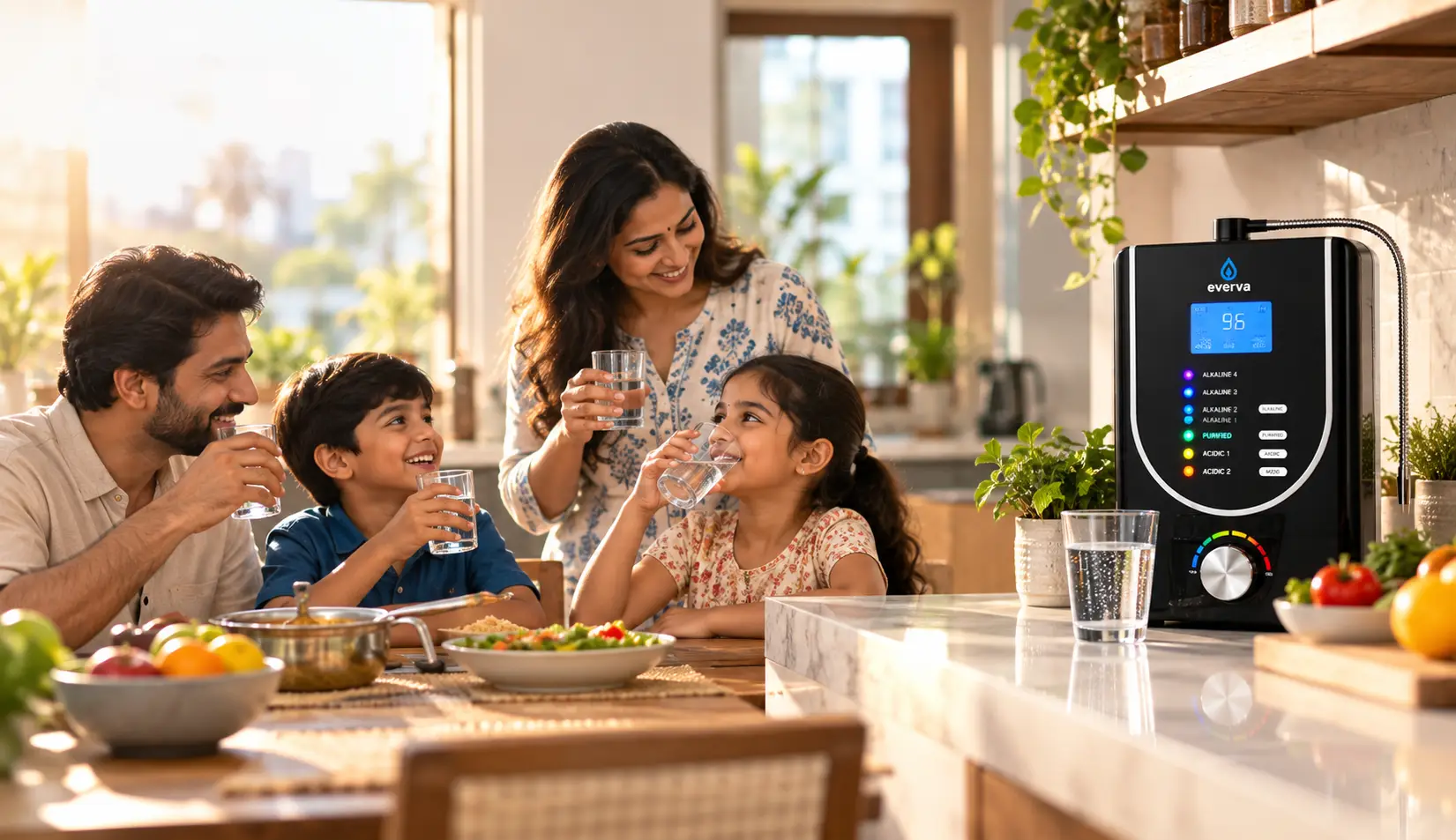
Everva can be used with compatible existing filters and purifiers to produce ionized, alkaline water. Depending on the setup, users can select different pH levels, including 8.5, 9.0 and 9.5.
The idea is simple:
Keep your existing water purification system where appropriate, and explore what comes next.
Rather than treating purification and water ionization as the same thing, Everva approaches them as complementary parts of a modern drinking-water setup.
The Bottom Line
For Indian families, water purification remains an important first step toward having suitable drinking water at home.
But it doesn’t have to be the end of the conversation.
As awareness around water quality, hydration and modern water technologies grows, families can look beyond simply filtering water and consider the characteristics of the water they drink every day.
Because the question isn’t only:
“Is our water purified?”
It can also be:
“What more can we do to make our everyday drinking-water experience better?”
Explore a smarter approach to drinking water with Everva—designed to work with compatible existing purification systems and bring ionize