

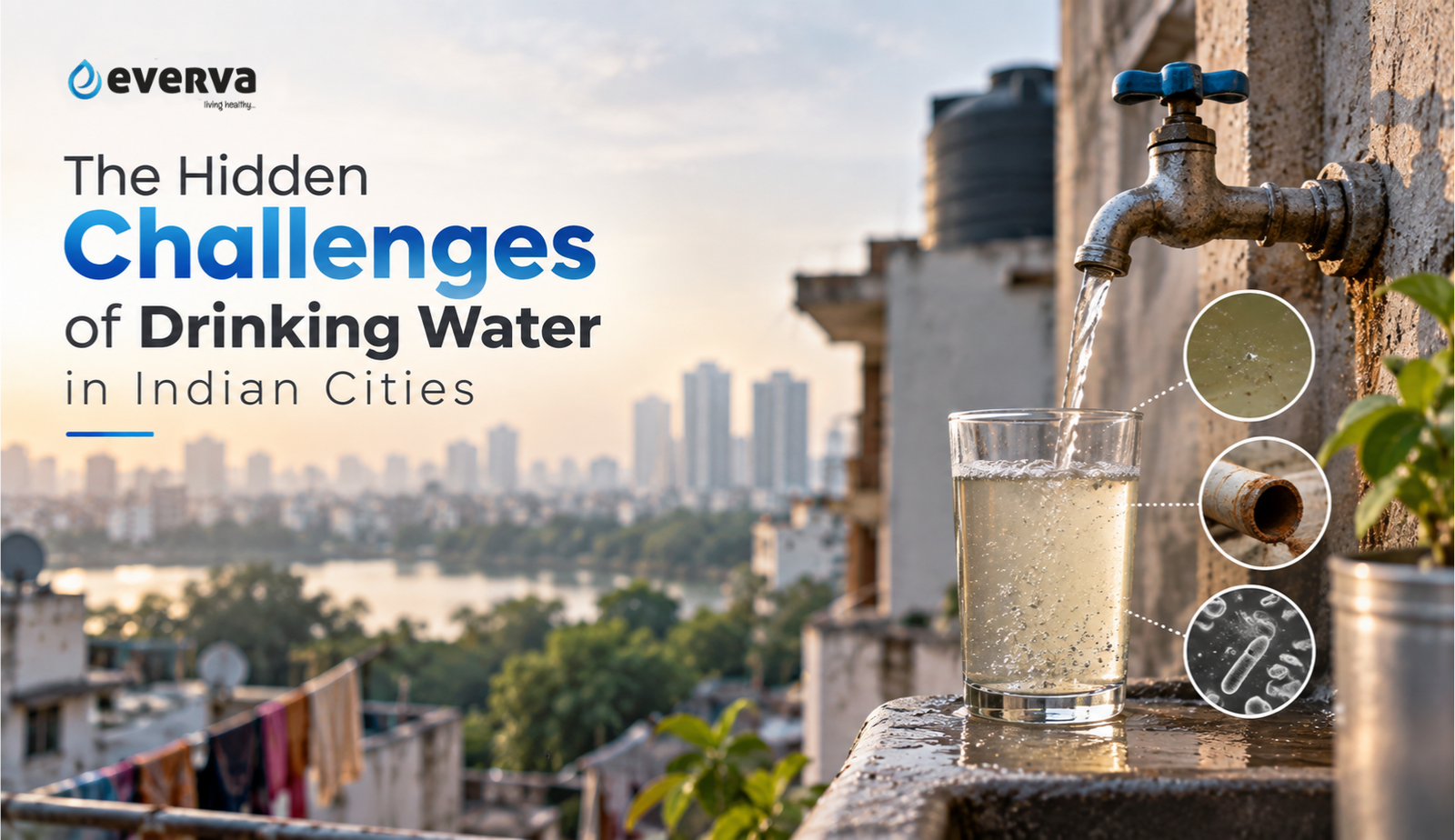
The quality of drinking water depends on much more than what comes out of a treatment plant. Water can be affected by its source, treatment, distribution network, storage and even the condition of household plumbing. The hidden challenge of drinking water quality in Indian cities is a more complicated issue than it may appear.
Turn on the tap, fill a glass, and the water may look perfectly normal. It may be clear, have no unusual smell and taste fine.
But does clear water always mean safe drinking water?
Not necessarily.
India has standards for drinking water quality. The Bureau of Indian Standards’ IS 10500 specifies requirements and testing methods for drinking water, covering physical, chemical, and microbiological parameters.
Source ~ (BIS)
1. Water Quality Can Change After Treatment
One common assumption is that once water has been treated, its quality remains unchanged until it reaches your home.
In reality, drinking water passes through a distribution system before it reaches the consumer. BIS’s framework for piped drinking-water supply management includes source intake, treatment, storage and distribution, highlighting that maintaining water quality involves the entire supply chain.
This means water treatment and water delivery are both important.
Problems in distribution infrastructure, interruptions in supply or poorly maintained systems can create additional water-quality concerns.
2. Ageing Pipes and Distribution Networks Matter
Urban water systems can involve extensive networks of pipes, tanks and connections. The condition of this infrastructure can influence the water reaching households.
This is why it is not enough to ask:
“Where does my water come from?”
A better question is:
“What happens to my water before it reaches my tap?”
Water quality needs to be considered from the source through treatment, distribution and final use.
3. Groundwater Is Not Automatically Pure
Many Indian households and buildings depend partly or entirely on groundwater.
Groundwater may look clean because it is naturally filtered through layers of soil and rock. However, it can contain naturally occurring minerals or become affected by human activity.
UNICEF India identifies groundwater depletion as a major concern and notes that groundwater supplies a substantial share of water requirements in urban India.
The quality of groundwater can also vary significantly depending on the location and local geology.
This is why testing your water source is more useful than judging water quality by appearance alone.
4. Chemical Contamination May Not Be Visible
One of the biggest hidden challenges is that some water-quality problems cannot be detected by simply looking at the water.
Depending on the source and surroundings, water can contain unwanted chemical substances. Indian drinking-water standards address parameters including fluoride, arsenic, lead, nitrate, iron, pesticides and several other substances.
UNICEF India also highlights chemical contamination, including fluoride and arsenic, as an ongoing water-quality concern in India. This is an important reminder:
Clear water is not necessarily proof of clean water.
5. Microbial Contamination Is Another Concern
Water can also become contaminated with microorganisms.
WHO links contaminated drinking water with diseases including diarrhoea, cholera, dysentery, hepatitis A, typhoid and polio.
Microbial safety is therefore a critical part of drinking-water quality.
This is also why water-quality standards don’t focus only on colour, taste or smell. They include microbiological testing and other parameters to assess whether water is suitable for human consumption.
6. Household Storage Can Become Part of the Problem
Even when the incoming water is adequately treated, how it is stored matters.
Many homes and apartment buildings use overhead or underground storage tanks. If these systems are not cleaned and maintained properly, they can become another point where water quality may be affected.
The same applies to household containers, plumbing, and filtration equipment.
Your water journey doesn’t end when it enters your building.
It continues until the moment you drink it.
7. Different Cities Can Have Different Water Challenges
There is no single water-quality story for every Indian city.
One location may depend heavily on groundwater. Another may rely primarily on municipal surface-water supplies. Some areas may experience hard water, while others may face concerns related to salinity, specific minerals, or contamination.
Even within the same city, water quality can differ between neighbourhoods and buildings because of differences in sources, infrastructure, and storage.
That is why choosing a water-treatment solution should begin with understanding your actual water source and its quality.
8. Water Purification and Water Ionization Are Not the Same
This distinction is important when choosing a home water system.
Purification focuses on reducing or removing contaminants according to the technology used and the characteristics of the incoming water.
Ionization, on the other hand, changes certain characteristics of suitable water through electrolysis, including its pH. These are different functions.
For households using a purifier or suitable filtered water, a water ionizer such as EVERVA can be considered as a separate step for producing alkaline ionized water.
The key idea is simple:
Purify according to your water quality. Then consider ionization.
A water ionizer should not automatically replace a purification system when the source water requires purification.
Choose technology based on the problem
Selecting an effective water-treatment method requires knowing the specific composition of your water supply and defining what you want the system to accomplish, as there is no single solution that fits all sources.
Where Does EVERVA Fit In?
EVERVA is a water-ionization system designed to work with suitable filtered or purified water.
Through electrolysis, the system produces different water outputs with different characteristics, including alkaline ionized drinking water.
For drinking purposes, EVERVA offers three alkaline water levels — pH 8.5, 9.0, and 9.5, while pH 7 is neutral.
The important point is that water quality comes first.
If your source water requires purification, address that requirement first. Once you have suitable water, ionization can be considered as an additional step based on your household’s preferences and needs.
The Real Challenge: Knowing What Is in Your Water
The biggest hidden challenge with urban drinking water is not always visible contamination.
It is uncertainty.
We often assume that water is safe because it looks clear, tastes normal, or comes through a municipal connection. But drinking-water quality involves the source, treatment, distribution, storage, and household handling.
Understanding those stages helps you make more informed decisions about water purification, filtration, and everyday drinking water.
Because better water choices start with one simple question:
Do you really know what is in the water you drink every day?
EVERVA — Drink Healthy. Drink Better.
Frequently Asked Questions
Is tap water safe to drink in Indian cities?
Safety depends on the water source, treatment, distribution system and household handling. Water quality can vary between cities and even between locations within the same city.
How can I check my drinking water quality at home?
Basic home test kits can provide limited information, but laboratory testing is more appropriate when you need reliable information about specific chemical or microbiological parameters.
Does clear water mean it is safe to drink?
No. Some chemical and microbiological contaminants cannot be detected through appearance alone.
Is groundwater safe for drinking?
Groundwater quality varies by location. It can contain naturally occurring minerals or contaminants, so testing is recommended when quality is uncertain.
Does a water ionizer purify water?
A water ionizer and a water purifier serve different purposes. Ionization changes characteristics such as pH through electrolysis; purification technologies are designed to reduce specific contaminants.
Why is water quality important for everyday wellness?
Safe drinking water is fundamental to health. Contaminated water can transmit infectious diseases, while chemical contamination can also create health concerns. (World Health Organization)