

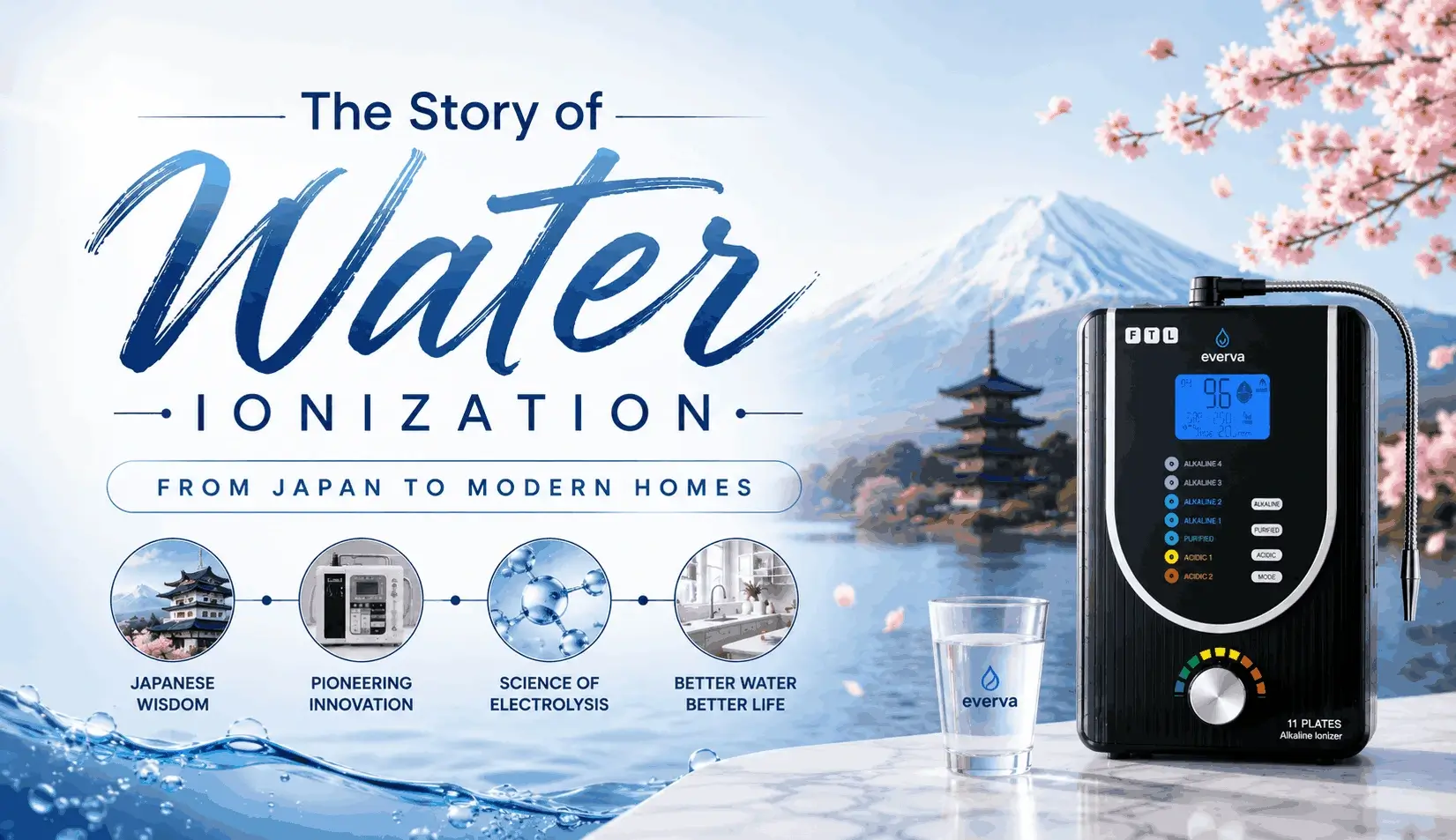
It All Started with One Curious Question
What if water could do more than just quench your thirst?
What began as a scientific curiosity became one of the most quietly influential innovations in home water technology: water ionization. The story of water ionization: From Japan to modern homes.
That one question sent Japanese researchers down a decades-long path of discovery. It has eventually reshaped the way millions of households think about the water coming out of their taps.
Today, that idea lives in kitchens and bathrooms all over the world.
Japan’s Obsession with Getting the Small Things Right
Japan has a well-earned reputation for taking everyday objects – a rice cooker, a toilet, a train schedule. Engineering them until they’re quietly brilliant. Water was no exception.
Back in the 1970s, researchers started asking a deceptively simple question: could electrolysis turn ordinary water into several different kinds of water, each suited to a different job around the home? Years of experimentation later, the answer was yes. And so it laid the foundation for the water ionizers we know today.
One thing researchers got right from the start: these machines were never meant to compete with water purifiers. They were designed to pick up where purification leaves off, adding a layer of usefulness that plain purified water couldn’t offer on its own.
From the Lab Bench to the Kitchen Counter
Ideas that start in a laboratory don’t always make it into daily life. This one did.
Families began to realize that a single countertop machine could hand them water for almost anything:
- Drinking
- Cooking
- Skincare
- Washing fruits and vegetables
- Cleaning around the house
It was a small mental shift with a big payoff. Water stopped being “just water” and became something you could tailor to the task at hand.
So How Does It Actually Work?
Here’s the part that sounds like science fiction but is refreshingly simple.
Purified water flows through a set of electrolysis plates inside the machine. A gentle electrical current nudges the water apart into different pH levels. Like some more alkaline, some more acidic, and each of those becomes useful for something different. Moving parts not to worry about and no complicated maintenance ritual. Just water, redirected a little more intelligently.
Where EVERVA Comes In
EVERVA takes that same Japanese-inspired ionization technology and builds it into a device made for modern homes. It plugs into your existing setup. No need to rip out your current purifier. And it turns already-purified water into multiple types suited for drinking, cooking, skincare, and cleaning.
It’s less a replacement for what you already have and more an upgrade to what your water can actually do for you.
Why This Story Matters Right Now
We’re living through a moment where people care more than ever about the following:
- Drinking water that actually supports hydration
- Keeping food genuinely clean, not just rinsed
- Cutting down on chemical-heavy cleaning products
- Making sustainable choices at home
- Technology that quietly makes life easier, not more complicated
Water ionization sits at the intersection of all five – which is probably why a decades-old Japanese innovation feels more relevant today than ever.
More Than a Machine
At its core, this isn’t really a story about technology. It’s a story about rethinking something we’ve taken for granted for our entire lives.
From the first glass you pour in the morning to the water you cook dinner with, wash your face with, or wipe your counters with, every use has a purpose. Water ionization simply asks, ‘Why should one type of water try to do all of that?’
Frequently Asked Questions
Why was water ionization developed?
It grew out of research into creating different types of water for different household needs through electrolysis, with its roots in Japan dating back to the 1970s.
Does a water ionizer replace an RO purifier?
No. It works after purification, building on your existing purifier by turning already-purified water into different pH levels for different uses.
Why is Japanese water ionization technology so well regarded?
Japan has led this field since the 1970s, developing the technology that’s now used in homes around the world.
Is EVERVA based on Japanese technology?
Yes. EVERVA is built on Japanese-inspired water ionization technology, adapted for modern households.